
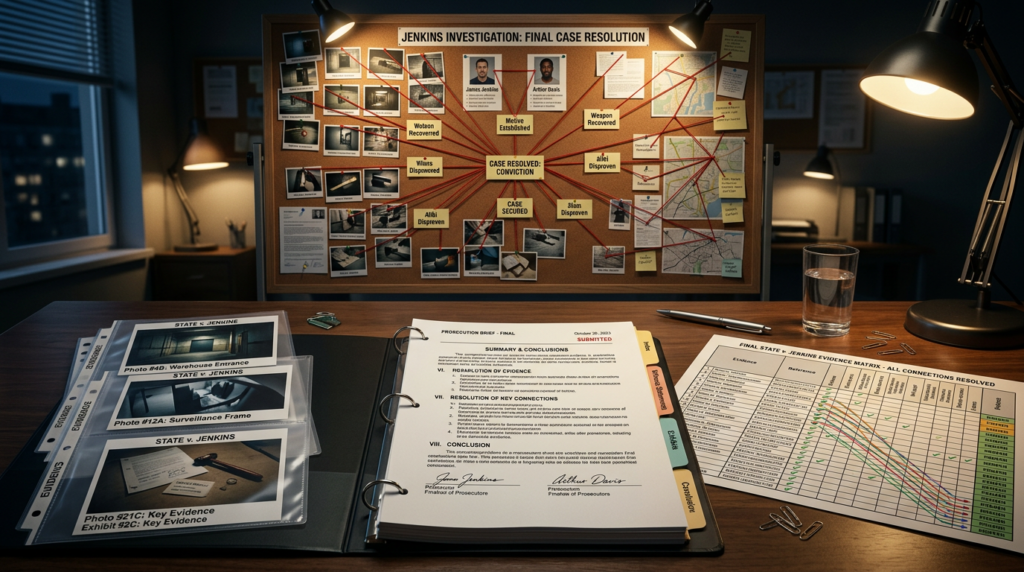
In the final stage of an investigation, the adrenaline of the chase fades, replaced by the cold, meticulous labor of the Prosecution Brief. For an Inspector, identifying the killer is only half the battle. The true victory lies in ensuring that the evidence is so logically sound, so physically undeniable, and so legally robust that it leaves zero room for reasonable doubt.
A “gut feeling” does not stand up in court. Intuition does not convince a jury. To close a case file for good, you must learn to synthesize your findings into a final brief, the ultimate weapon of the justice system.
The Burden of Proof: Beyond Reasonable Doubt
In a criminal trial, the prosecution must meet the highest standard of proof. As an Inspector, your job is to anticipate the “Defense Narrative.” Before you submit your file, you must play the role of the defense attorney and try to tear your own case apart.
The “Reasonable Doubt” Test:
- The “Other Person” Theory: Can the physical evidence be explained by the presence of a third party you haven’t identified?
- The “Contamination” Argument: Is there any gap in the Chain of Custody that allows a lawyer to claim the evidence was planted or compromised?
- The “Coincidence” Defense: Is your evidence purely circumstantial? (e.g., “My client was at the park, but so were fifty other people.”)
If your brief cannot answer these questions, the file is not ready to be closed.
Constructing the Evidence Matrix
An Inspector does not just hand over a folder of clues; they build an Evidence Matrix. This is a grid that aligns every piece of evidence with a specific element of the crime.
The Four Pillars of the Matrix:
- Means: Does the suspect have the physical ability, the technical knowledge, or the specific weapon required to commit the act? (e.g., A specific software exploit found on their laptop).
- Motive: Why did they act? (e.g., the life insurance policy or the blackmail threat discovered in the victim’s “Secret Life”).
- Opportunity: Does the Alibi Audit prove they were physically present at the scene during the Time of Death?
- Intent: Can you prove the act was premeditated? (e.g., The “Digital Shadows” in their search history three days prior).
The Golden Rule: You need at least three of these pillars to be supported by Direct Evidence (Physical/Digital) rather than just Circumstantial Evidence (Witness testimony).
The “Corroboration Pyramid”
A single piece of evidence is a thread; corroborated evidence is a cable. To make your brief “unbreakable,” you must look for Multimodal Corroboration.
- Level 1 (Weak): A witness says they saw the suspect’s car.
- Level 2 (Stronger): CCTV shows a car matching that description in the area.
- Level 3 (Unshakeable): Automated License Plate Recognition (ALPR) pings the suspect’s specific plate, and the vehicle’s internal GPS “Black Box” shows the engine was turned off at the scene.
When your brief reaches Level 3 corroboration across all four pillars, the defense has nowhere to hide.
The Final Summary: The Narrative of Guilt
Juries respond to Narrative. Your brief must tell a story that is supported by facts. An Inspector’s final summary should follow this structure:
- The Predicate: What was the “Catalyst” that set the crime in motion?
- The Execution: How did the suspect bypass the victim’s defenses? (Use your Behavioral Profiling insights).
- The Cover-Up: How did the suspect attempt to deceive the investigation? (Detail the Staging or the Manufactured Alibi).
- The Logical Conclusion: Explain why, out of every possible scenario, only this suspect, with this motive and this opportunity, could have committed this act.
The Inspector’s Final Protocol
Before you click “Submit Case” in your Cold Case Inc portal, perform this 3-step integrity check:
Step 1: The Exclusionary Sweep
Look at your secondary suspects one last time. Can you definitively prove they couldn’t have done it? (e.g., “Suspect B has a verified GPS ping 50 miles away at the TOD”). By excluding everyone else, you strengthen the focus on your primary target.
Step 2: The “Link Analysis” Finalization
Ensure your Network Analysis chart is complete. If your suspect had a co-conspirator, have you identified them? A brief that ignores a second set of fingerprints at the scene is a brief that will be rejected.
Step 3: The “So What?” Factor
Review every piece of evidence and ask, “So what?” If a piece of evidence doesn’t directly prove Means, Motive, Opportunity, or Intent, remove it. A clean, lean brief is far more effective than a cluttered one.
Practical Lab: Put It To The Test
You have moved from the fundamentals to the dark arts of the psyche. Now, it’s time to prove you can hold the line in the face of justice.
Your Final Assignment:
Open your active case file. Collect your “Evidence Matrix.” Ensure your timeline is stress-tested, your victimology is complete, and your suspect’s alibi is shattered. Compile your findings into the final report. Do not guess. Do not assume. Prove it.
LAB ASSESSMENT: ARTICLE 15
Evidence is only as strong as its presentation. Are you ready to file the Prosecution Brief?



Leave a Reply
You must be logged in to post a comment.